
Published by: Varam Integrated
             Corporation
V.O. Chidambaranar (VOC) Port, formerly known as Tuticorin Port, is one of India’s leading major ports located on the southeast coast of Tamil Nadu. Strategically positioned close to the East–West international shipping route, the port serves as a vital gateway for international trade, connecting India with Sri Lanka, the Maldives, Southeast Asia, the Middle East, Africa, and Europe.
The port handles millions of tonnes of cargo every year, including containers, bulk cargo, breakbulk, liquid cargo, project cargo, heavy machinery, automobiles, agricultural commodities, minerals, fertilizers, cement, steel, petroleum products, and renewable energy equipment.
Whether you are a ship owner, charterer, exporter, importer, freight forwarder, or logistics provider, understanding the vessel berthing process at VOC Port helps ensure efficient voyage planning and smooth cargo operations.
Overview of VOC Port
VOC Port is one of the 12 Major Ports of India and offers modern infrastructure, deep-water berths, advanced cargo-handling equipment, and excellent multimodal connectivity through road and rail networks.
Strategic Advantages
Located close to international shipping lanes
Excellent connectivity to South India
Gateway to Sri Lanka and Maldives
Deep-water harbour
Modern container terminals
Specialized bulk and project cargo facilities
Efficient customs and port operations
24×7 marine services
Operational Port Areas
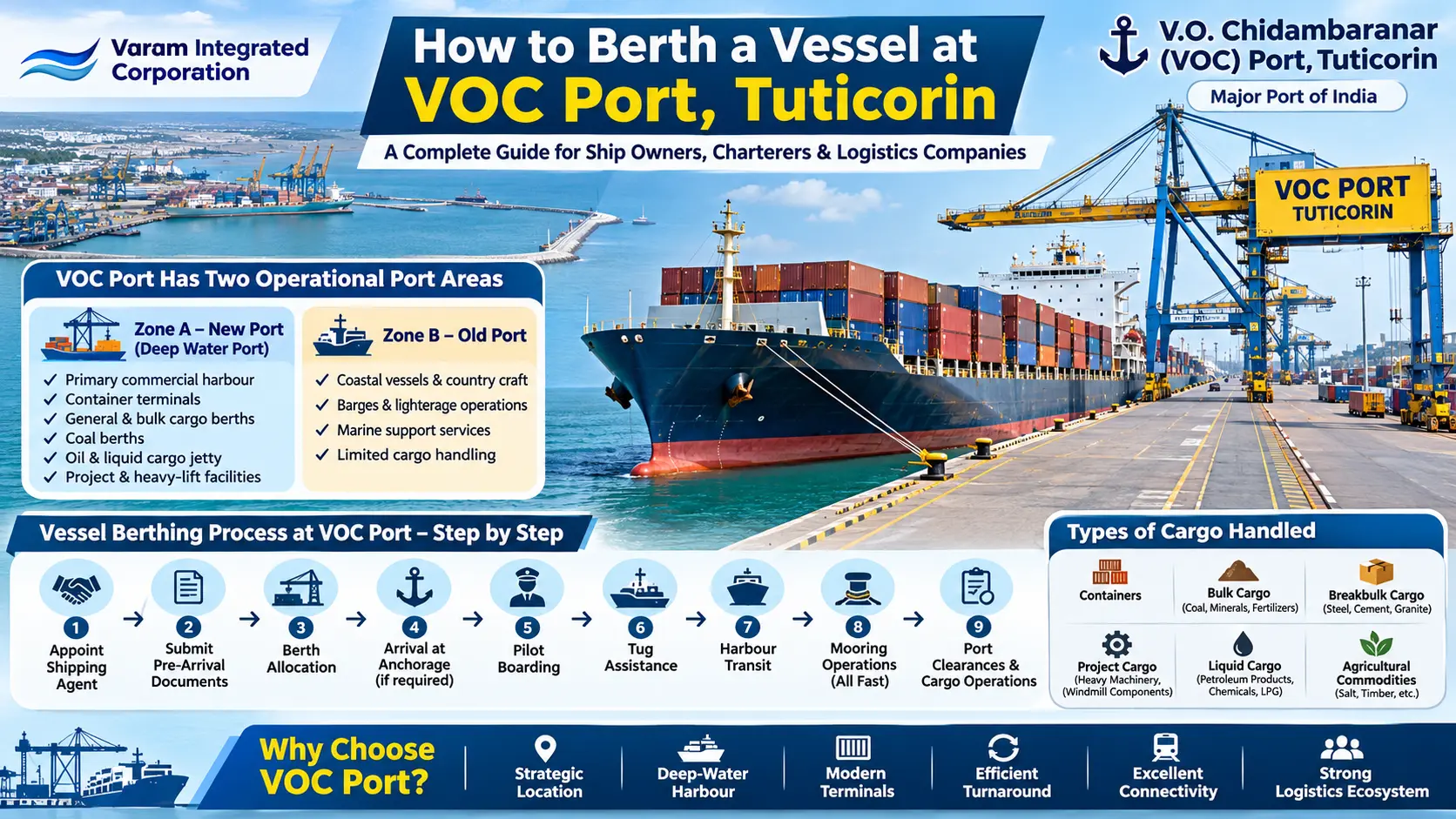
VOC Port operates across two distinct commercial zones:
1. New Port (Zone A)
The New Port serves as the primary commercial deep-water harbour where the vast majority of international commercial vessels call.
Facilities Available: Container terminals, general cargo berths, dry bulk berths, coal berths, oil jetty, liquid cargo berths, coastal cargo facilities, project cargo handling yards, and heavy-lift handling infrastructure.
Vessel Types Accommodated: Container ships, bulk carriers, oil/chemical tankers, multipurpose vessels, heavy-lift vessels, and coastal cargo carriers.
2. Old Port (Zone B)
The Old Port supports shallow-draft operations, regional logistics, and marine services:
Coastal shipping and feeder movements
Barges and country craft
Lighterage and mid-stream operations
Marine tug and pilot launch base operations
Specialized regional short-sea cargo
Step-by-Step Vessel Berthing Process
Step 1: Voyage Planning & Agent Appointment
Prior to vessel dispatch, the ship owner or charterer appoints a licensed local steamer/shipping agent. The agent handles mandatory regulatory clearances with:
Port Authority & Marine Department
Harbour Master & Pilotage Control
Indian Customs & Immigration Authorities
Port Health Organization (PHO)
Terminal Operators, Stevedores, & Surveyors
Step 2: Pre-Arrival Documentation
Statutory documents must be filed via the national maritime single-window system prior to arrival:
Notice of Arrival (NOA)
Detailed Cargo Manifest & Stowage Plan
Crew List & Last Port Clearance (LPC)
Statutory International Maritime Safety & Class Certificates
Dangerous Goods (DG) Declarations (if applicable)
ISPS Security Declarations & P&I Insurance Coverage Details
Step 3: Berth Allocation
The VOC Port Traffic Department evaluates operational parameters during daily berthing meetings to assign a designated berth. Allocation factors include:
Length Overall (LOA), beam, and arrival draft
Cargo classification, parcel size, and handling gear availability
Target terminal productivity and existing berth occupancy
Dynamic tidal windows and prevailing sea conditions
Port priority guidelines (e.g., liner priority, coastal vessel priority)
Step 4: Arrival at Anchorage
If the allocated berth is occupied or documentation is pending, the vessel anchors safely in the designated VOC Port outer anchorage. During anchorage:
Marine pilot boarding schedules are confirmed
Harbor tug requirements are assigned
Customs border and inward clearance processes finalize
Free pratique is verified
Step 5: Pilot Boarding
A licensed marine pilot boards the vessel via pilot launch at the fairway buoy/pilot boarding station. The pilot navigates the vessel through:
Outer Navigation Channel
Harbor Breakwaters
Turning Basin
Direct Approach to the Assigned Quay
Step 6: Tug Assistance
Depending on the vessel’s displacement, draft, maneuvering gear (e.g., bow thrusters), and tidal currents, dedicated harbor tugs assist with turning, positioning, and pushing the vessel safely alongside the wharf.
Step 7: Mooring Operations
Harbor mooring crews secure the vessel to shore bollards using a standard mooring pattern:
Head lines & stern lines
Breast lines
Forward and aft spring lines
Once tension is set and the gangway is rigged, the vessel is officially declared “All Fast.”
Cargo Operations by Cargo Type
Cargo discharge and loading commence immediately following customs inspection and stevedoring clearance:
Containerized Cargo: Handled via post-panamax Ship-to-Shore (STS) gantry cranes, Rubber-Tyred Gantry (RTG) cranes, and internal terminal tractor-trailers.
Breakbulk Cargo: Managed via high-capacity Mobile Harbour Cranes (MHC), vessel ship-board cranes, heavy forklifts, and spreader bars.
Dry Bulk Cargo: Discharged/loaded using high-capacity grab cranes, hoppers, continuous conveyor belt networks, and stacker-reclaimers.
Liquid Cargo: Discharged via dedicated Marine Loading Arms (MLAs), high-volume booster pumping stations, and direct shore pipeline connections.
Project Cargo: Handled using tandem-lift mobile harbor cranes, hydraulic multi-axle modular trailers, specialized lifting gear, and on-site engineering oversight.
Completion of Cargo Operations & Unberthing
Following cargo completion:
Joint cargo tally and draft surveys are finalized.
Export/import customs clearances and port out-clearance certificates are issued.
Terminal dues, port tariffs, and pilotage fees are settled.
Pilotage and unberthing tug operations are scheduled.
Departure Sequence
Marine pilot boards the bridge.
Mooring crews release lines sequentially.
Tugs pull the vessel clear into the turning basin.
The ship proceeds outbound along the navigation channel.
The pilot disembarks at the outer limit, and the vessel sets passage to its next port of call.
Cargoes Handled at VOC Port
Unitized & General Cargo: Containers (FCL/LCL), breakbulk, project cargo, and heavy machinery.
Renewable Energy Infrastructure: Wind turbine blades, towers, nacelles, and solar panels.
Dry Bulk Commodities: Thermal & coking coal, copper concentrate, fertilizers, rock phosphate, cement, clinker, salt, timber, and grains.
Liquid Bulk: Petroleum products, industrial chemicals, LPG, and edible oils.
Key Advantages of VOC Port
Strategic Geographic Location: Immediate proximity to the East–West global shipping corridor minimizes vessel deviation time.
All-Weather Harbor: Deep-water operational channels protected by substantial breakwater infrastructure.
High Efficiency: Swift vessel turnaround times, modernized handling equipment, and direct rail-side container access.
Multimodal Logistics: Seamless road links to NH-44 and dedicated broad-gauge rail sidings linking peninsular India.
Competitive Port Tariffs: Cost-effective port tariffs and cargo-handling charges relative to major regional alternatives.
How Varam Integrated Corporation Can Assist
Varam Integrated Corporation delivers comprehensive, end-to-end maritime and supply chain solutions across South India:
Port Agency & Vessel Husbandry Support
Customs Clearance & Regulatory Compliance
Ocean Freight Forwarding & Multimodal Logistics
Project Cargo & Over-Dimensional Cargo (ODC) Movement
Heavy-Lift Engineering & Industrial Packaging Solutions
Global Sourcing & Supply Chain Procurement
Contact Us
Varam Integrated Corporation
International Sourcing | Export Logistics | Marine & Port Solutions | Supply Chain Management
Email: info@rathani.com
Website: www.rathani.com
Phone: +91 83005 29399
Final Thoughts
V.O. Chidambaranar (VOC) Port continues to expand its footprint as an essential maritime hub in South Asia. With strategic expansions in deep draft berths, enhanced green port initiatives, and world-class cargo facilities across Zone A and Zone B, the port provides ship owners, charterers, and industrial shippers with unparalleled operational efficiency and route reliability.
Keywords: VOC Port, Tuticorin Port, V.O. Chidambaranar Port, Vessel Berthing, Shipping Agent India, Container Port India, Breakbulk Cargo, Project Cargo, Marine Logistics, Export Logistics, Ship Agency, Freight Forwarding, Port Operations, South India Port, International Shipping.